
by Xavier Iturbide Godínez
The religious architectural work of Guadalajara is rich and extensive. Like any city founded by Spanish conquerors in the Americas, the Catholic Church established its temple in the center of the city, a point from which urbanization radiated, typically in a grid pattern as was the case with Guadalajara. Religious orders traveled alongside the conquerors with the aim of evangelizing the indigenous populations of the territories they arrived in.
Guadalajara was founded for the fourth time in 1542 at its present location. However, a year earlier, a temple had been built, named the cathedral, where the Temple of Santa María de Gracia stands today. This temple, constructed from adobe with a thatched wooden roof, caught fire not many years later.
Dating the construction date of the oldest temples in the city is not an easy task, and it’s also not an exact science. There are many factors: the start date of construction, the completion date of the works, the dedication date of the temple, the opinions and research of various authors. Many times, the buildings that exist today are total reconstructions of the earlier temples, and that creates confusion. For example, most online sources set the construction date of the Mexicaltzingo Temple as the year 1541, which would make it the oldest in the city. However, we know that the temple that stands in the same location today is a complete reconstruction that began in 1803 and was mostly completed by 1808. Nothing remains of that chapel that was started to be built in the 16th century.
For this list, I decided to take the start date of construction of the temple that still retains some part of its original structure or plan. The vast majority of the temples, if not all of them, have been intervened, reconstructed, remodeled, altered, and/or expanded throughout their history. Today, none of the temples mentioned in this list remains the same as when it was «completed» for the first time. Even the Metropolitan Cathedral itself recently had solar panels installed on its roof (which aesthetically affects its appearance when viewed from above) because apparently, alms are no longer sufficient to pay the electricity bill.
1. San José de Analco – 1543
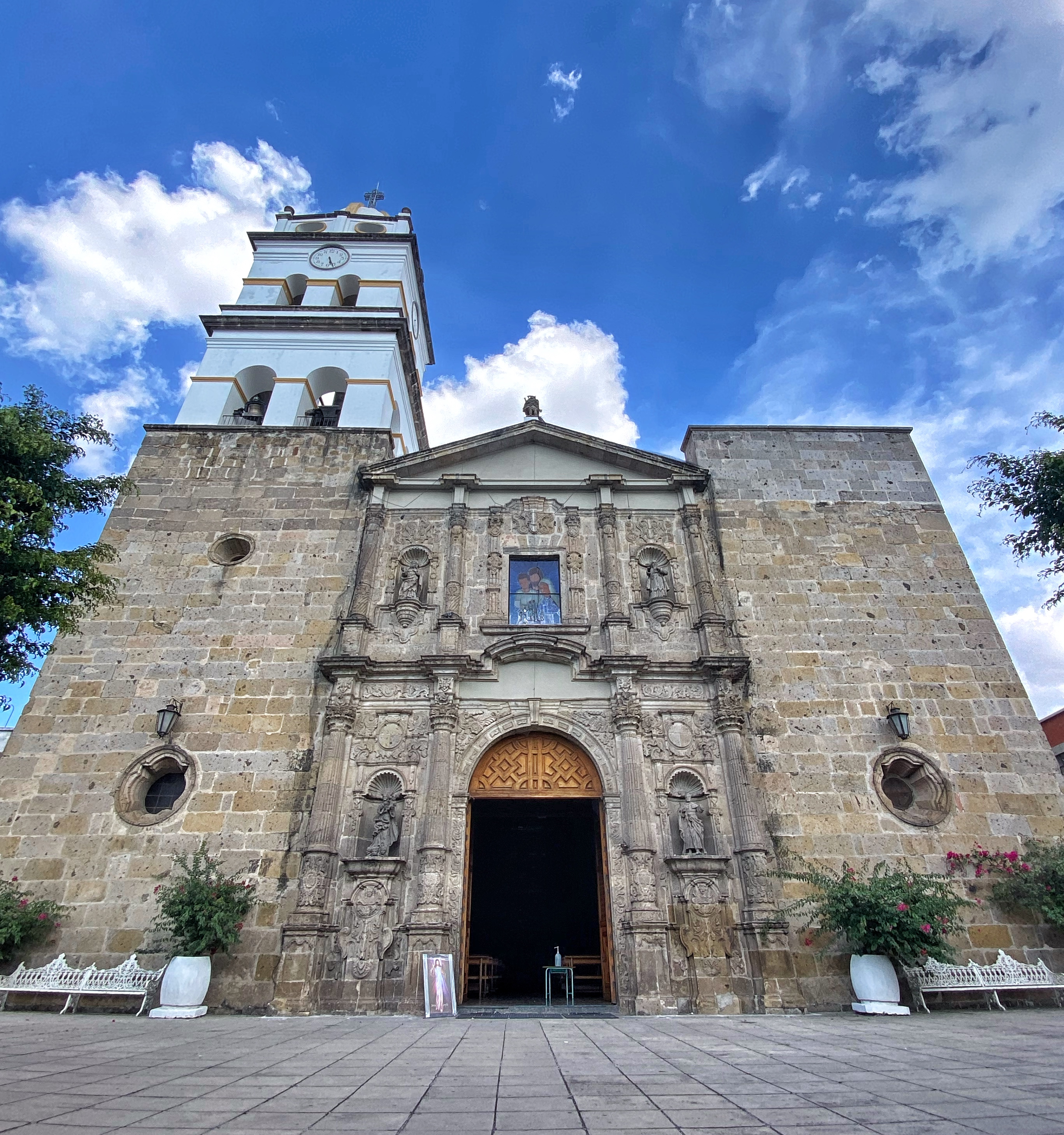
Nothing visible to the naked eye remains of the hermitage that was erected in this place in 1543, except for the site and the name: San José de Analco. The thing is, aside from the expansions and reconstructions that are normal in the life of churches, this particular temple has unfortunately suffered interventions that have altered its style despite its importance. The most recent of these took place in the late 19th century when its interior was almost entirely remodeled. In San José Analco, it’s possible to see on its walls the different construction stages, distinguishing the various sizes, styles, and colors of its stones and ornaments.
The current structure of the church corresponds, for the most part, to the 17th century. However, we presume that the courtyard and general arrangement of the temple that we see today, despite its various reconstructions and expansions, are remnants of the original from the 16th century. The standout part is undoubtedly its façade, which some call Plateresque, but undoubtedly features fine reliefs with natural motifs framed by fluted columns with composite capitals. At some point, probably in the 19th century, an unfortunate tympanum was added, which disrupts the overall composition due to the neoclassical trend that transformed—causing a loss of architectural value—in nearly all the temples of the city. You can see on the lateral bodies how they rise to the height of the mentioned tympanum and pediment, as part of the neoclassical remodeling.

2. San Sebastián de Analco – c. 1550

Its location and construction date give rise to debate, as surely do the rest of the temples. The information regarding the origins of the chapel of San Sebastián de Analco is scarce when it comes to its construction stages prior to the Baroque temple. However, the first written mention that is preserved of the hermitage, which would later become a temple, dates back to 1560, written by Alberto Santoscoy:
«On December 10, 1560, an unusual movement was noticed in the city of Guadalajara de Indias, belonging to the Kingdom of New Galicia. The multitude hurried westward from the town, leaving to their right the Hermitage of San Sebastián, to meet the judges, the highest-ranking magistrates who were coming to establish the Royal Audience.»
Like all hermitages of that era, its construction was of adobe with a thatched roof, and its construction, carried out by the indigenous Cocas and Tecuexes, was directed by the Franciscan friars. Over time, the temple began to expand, and we know that most of the structure seen today dates from the late 17th century when the town of San José de Analco was designated as a district of Guadalajara.
The central temple dedicated to San Sebastián is flanked by two chapels; the first dedicated to Our Lady of Guadalupe and the second called the Calvary Chapel. The most precise architectural description continues in this magnificent depiction by José Alfredo Alcántar:
«The architectural plan of San Sebastián is basilical in type, with three aisles and five bays, divided by cylindrical pillars that support an archway in a north-south direction. The supports are of the tritostyle type with engaged pilasters, resting on nearly square pedestals. The central nave is of greater height and allows the presence of elliptical profile skylights arranged horizontally, aligned with the axis of the arches. It has an under-gallery, an element that creates spatial stepping and functions as the former narthex intended for catechumens. The roofs of the three aisles are flat and have groin vaults in the presbytery; the aforementioned flat surfaces replace the former traditional system of wooden beams with terracotta. They now display vaults made of wedge-shaped bricks on iron beams. The presbytery has a square base, with lateral ventilation through rectangular windows above the cornices; it features a triumphal arch, and the most elaborate ceiling of the architectural ensemble is composed of ribbed tiercerons, the formal result of which is defined by a flower motif on the intrados. The shrine is located on its western side, and the west side is occupied by the sacristy.»
José Alfredo Alcántar Gutiérrez, Franciscan Temples in the Analco District, Jalisco Studies 115, University of Guadalajara, 2019, p.66

3. Guadalajara Cathedral – 1561

The unique architectural style that distinguishes the Guadalajara Cathedral is so recognizable that it has been the city’s ultimate symbol for many years. Its facade, consisting of 5 levels in a restrained neoclassical style, topped by an arched pediment at the center with a clock, is instantly recognizable. Its neo-Gothic towers, covered with Sayula tiles, ultimately define a distinct silhouette that makes this building the quintessential landmark of Guadalajara.
As mentioned before, the first Guadalajara Cathedral was not located where the current one stands. It was situated three blocks to the east, at the site where the Temple of Santa María de Gracia now stands. That church, dating back to the city’s founding era, was a simple construction with adobe walls and a thatched roof. As expected, such a fragile structure didn’t last long (it’s said to have burned down due to a mass celebration). Finally, in 1561, a royal decree authorized the construction of a new building at the current location. The foundation stone was laid on July 31 of the same year, which is why we chose this date as the start of the project. It’s believed that the actual construction may have begun around 1573 or 1574, as various sources mention. However, the laying of the foundation stone, even if only one, marks the official beginning.
Martin Casillas is frequently named as the master responsible for the design and construction of the Cathedral. This is incorrect, as it is known that the master builder worked on the construction of the Mexico City Cathedral until 1585 and is not mentioned as a worker or master of the Guadalajara Cathedral until 1593, 32 years after the start of the temple’s construction. However, he did take charge of the work as the Chief Master from 1599 until his death in 1618, which is also considered the completion date of the project.
As we mentioned, churches take a long time to build, and their designs change over time. Therefore, it wasn’t until 1716 that the building was consecrated as a Cathedral, and it wasn’t until 1854 that architect Manuel Gómez Ibarra completed the current towers he designed in an eclectic style some call neo-Gothic, replacing the previous ones that had fallen during the earthquake of 1818.

4. San Francisco de Asís – 1580

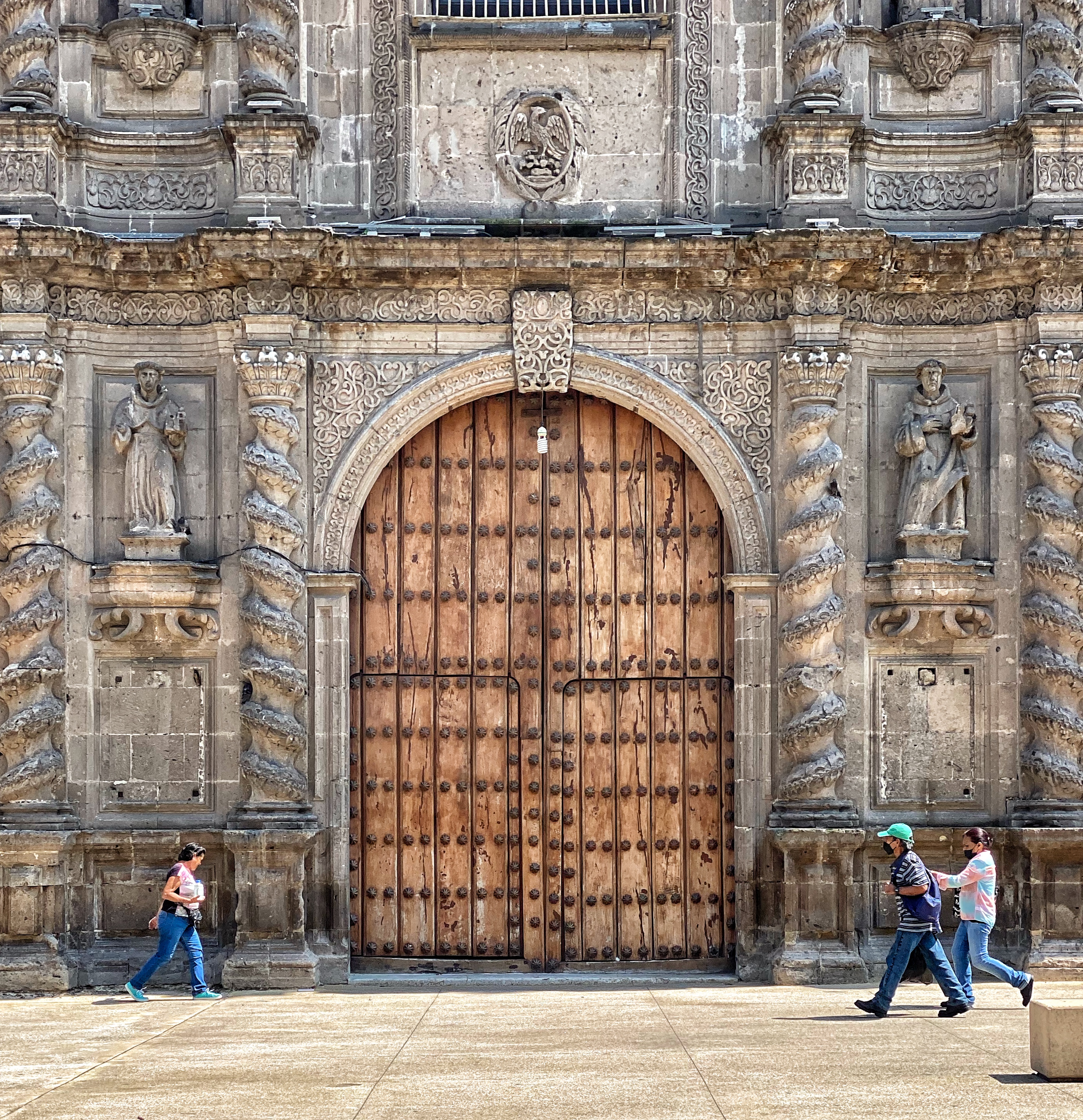
This temple was part of the Franciscan monastery that was established nearly simultaneously with the city’s foundation. We know that the construction of the temple began in 1580, although it’s also true that a significant portion of the temple we see today dates back to the late 17th century when it was decided to expand it around 1668. However, this expansion was carried out on a significant portion of the original foundations of the 16th-century temple.
The bell tower is a replica of the original cathedral’s. Its facade, composed of three sections in a Baroque style, is a product of the 17th-century expansion, and its noteworthy Solomonian columns, framing the entrance, are also replicas of those on the Cathedral. Trends change, and churches are no exception to the rule; in 1825, the lavish Churrigueresque interiors were replaced by Neoclassical altars, which were fashionable at the time. A fire, reportedly caused by an accident, necessitated the complete interior reconstruction in 1936.
In 1860, as a consequence of Juárez and the Reform Laws, the monastery was secularized. In 1861, the chapels of San Antonio de Padua and San Roque were demolished, along with the stone wall that surrounded the convent. Part of the convent was sold. The grounds of the orchard hosted the Central Mexican Railway Station, located precisely behind the temple, which opened in 1888. In the center of the San Francisco garden stood the monument to General Ramón Corona, now located on Calzada Independencia.
5. San Agustín – 1587
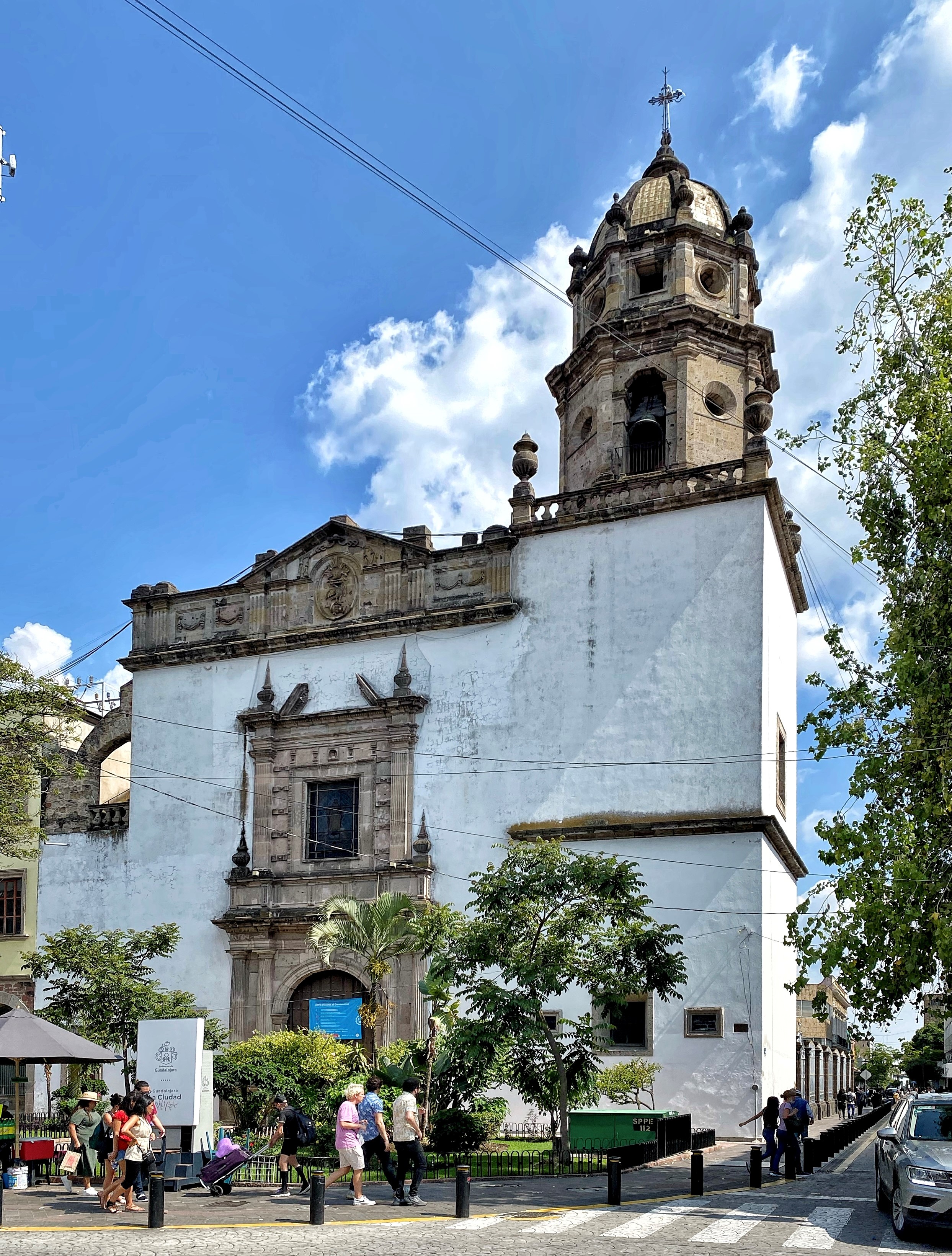
Another temple that was originally part of a convent, belonging to the Augustinian order. In 1574, this order began constructing a temporary temple on the site. Unlike the common practice of orienting temples east-west, the San Agustin temple is situated with a north-south orientation. This was likely because it faced the Plaza Mayor. Remember that at that time, the Cathedral was located where the Temple of Santa María de Gracia stands today, and it wasn’t until 1618 that the current Cathedral was put into operation. In 1592, the space now known as Plaza de Armas was designated as the Plaza Mayor, diminishing the importance of the area in front of the temple, which turned into a market.
On July 21, 1587, Friar Juan de San Sebastián, the Prior of the Convent, purchased houses located on a street called San Agustín, behind the Plaza de la Real Audiencia. This marked the beginning of the construction of the Guadalajara temple and convent, under the patronage of San José de Gracia. It was only in 1674 that Friar José Rodríguez, in charge of the project, requested the Audiencia and the City Council for more land, including space for a cemetery. It was finally in that year that the construction of the church was completed.
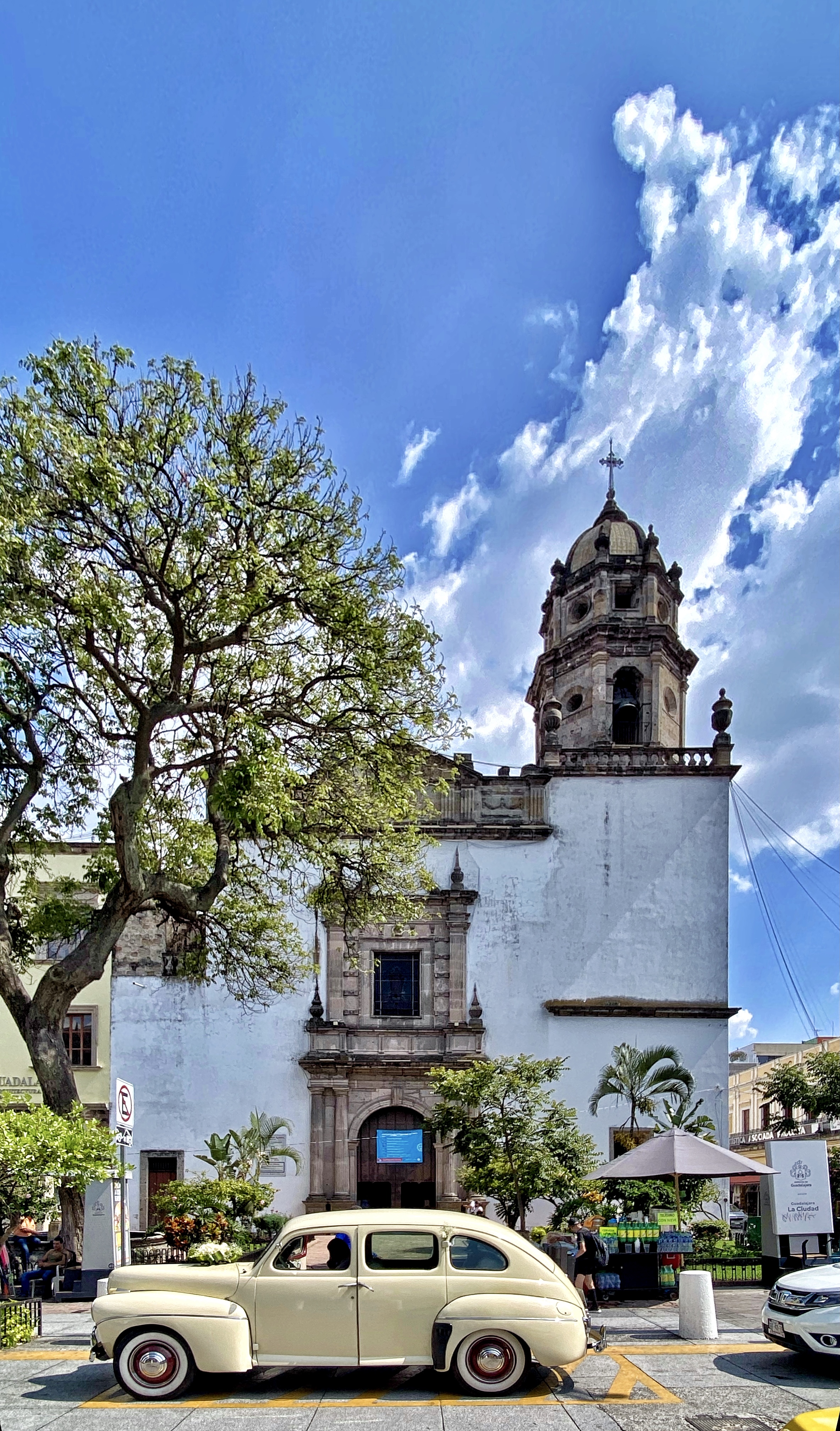
The temple is simple, of the Baroque style, but it’s not overloaded with decorations like other examples of the era. Nevertheless, it remains elegant. Ruiz Razura describes it as follows:
«The temple fits within the realm of restrained Baroque; it has a single nave, without a transept, thus lacking a dome with ribbed vaults. Its facade consists of two levels; the first adorned with a round arch with paired columns with fluted shafts at the entrance. The entablature is decorated with triglyphs and blind metopes. The second level features a rectangular choir window with an interrupted pediment and a pilaster on each side crowned with Gothic-style pinnacles. Small pilasters that resemble triglyphs appear on the upper cornice.»
Ruiz Razura, op. ed. p. 39
The interior of San Agustín underwent a neoclassical transformation in the 19th century, which characterizes the majority of the temples in Guadalajara. However, the exterior successfully resisted this change, and today we can still appreciate its restrained Baroque elegance.
*Notary Public, Mexico, August 15, 1593, agncm, notary 375: Juan Bautista Moreno, volume 2483, pages 394r-395v and page 430r-v.
**Adriana Ruiz Razura, The San Agustín Convent in Guadalajara, Jalisco Studies 115, University of Guadalajara, 2019, p. 66.
***Claudio Jiménez y Vizcarra. The Camarena Building, Glimpses of Its Past. Guadalajara: Meritorious Society of Geography and Statistics of Jalisco, 2011, p. 15.

 Revisiones de Guadalajara